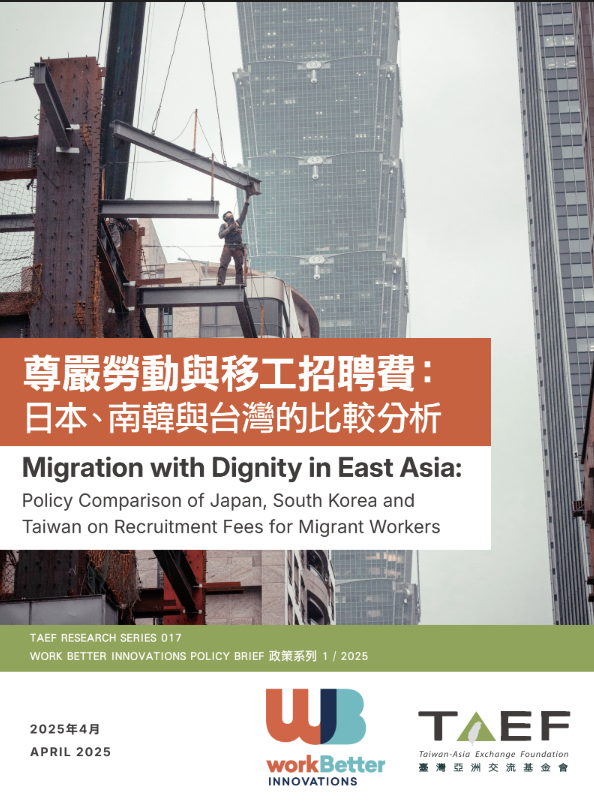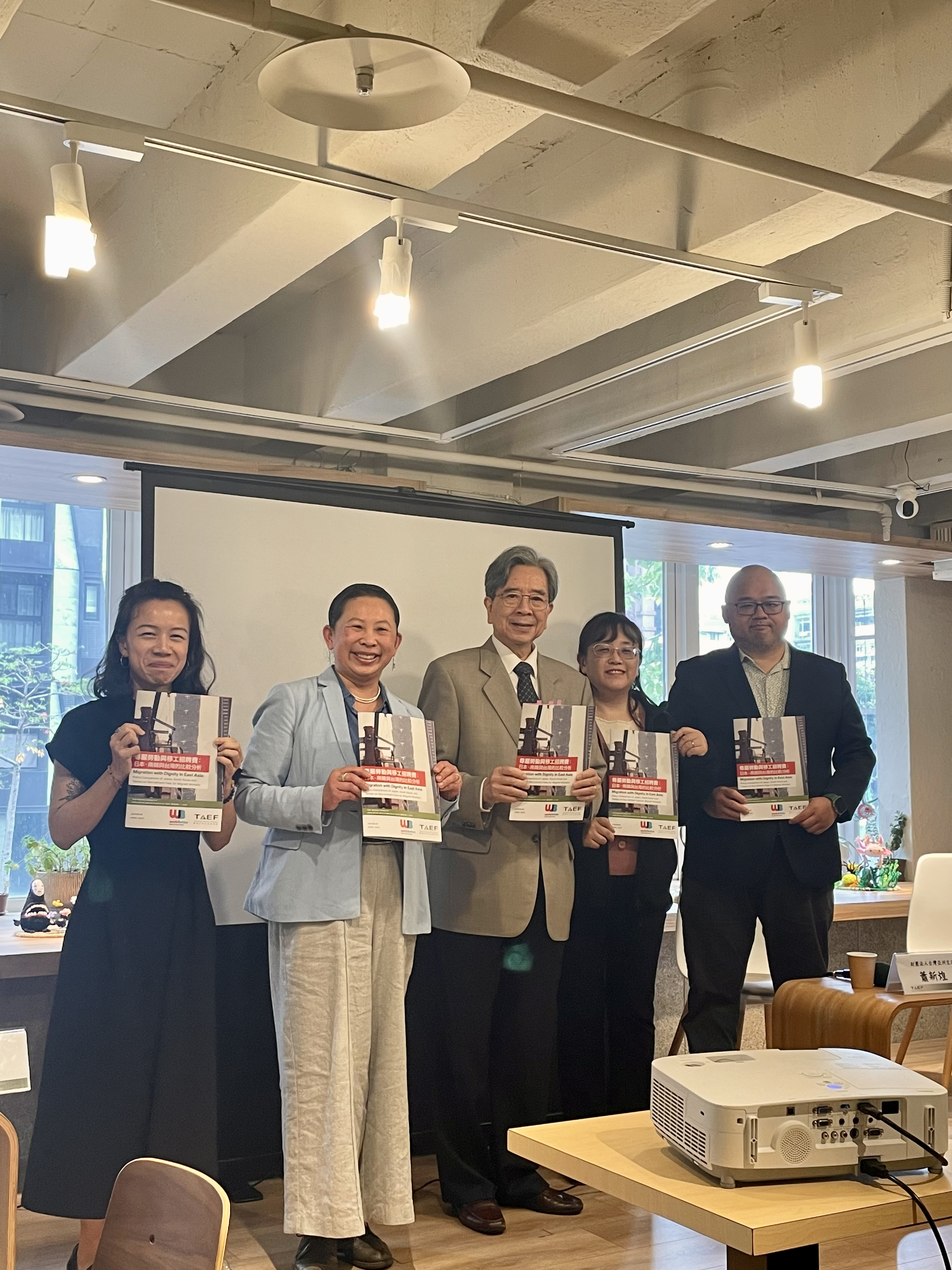
On April 28, the Taiwan-Asia Exchange Foundation (TAEF) is delighted to collaborate with Work Better Innovations (WBI), a community interest company based in the UK, to launch their recently released report Migration with Dignity in East Asia: Policy: Comparison of Japan, South Korea and Taiwan on Recruitment Fees for Migrant Workers. TAEF is also honoured that the Executive Director of WBI Bonny Ling (凌怡華), along with our Chairman, Dr Hsin-Huang Michael Hisao and Division Chief of Cross-Border Workforce Affairs Centre, Mrs Hsiao Chiu Yu (于曉秋) from the Ministry of Labour gave remarks for the opening of the dialogue. The report focused on recruitment fees, examining the similarities and challenges of cross-border labour management policies between Japan, South Korea, and Taiwan and provided valuable insight into future policy reform directions.
Dr. Hsin-Huang Michael Hsiao, Chairman of TAEF, remarked in his address that since TAEF’s establishment in 2018, the Foundation has remained committed to advancing the New Southbound Policy as its core mission, strengthening Taiwan’s cooperation with Southeast Asia, South Asia, Australia, and New Zealand. In recent years, TAEF has also actively expanded into new areas such as “semiconductor diplomacy,” “economic diplomacy,” and “health diplomacy” to deepen regional linkages.
Dr. Hsiao noted the growing “Southeast Asia phenomenon” in Taiwan, reflected primarily in the communities of marriage migrants and migrant workers. Ensuring fair treatment and strong human rights protections for migrant workers in Taiwan, he emphasized, would demonstrate Taiwan’s sincerity and capacity in implementing the New Southbound Policy—because “doing the right thing must start at home.”
The collaboration with WBI on research into recruitment-fee systems, he said, marks “the first step in migrant worker policy reform.”
He stressed that while the current report focuses on “migration with dignity,” the research also holds potential for extension into issues such as “marriage migration with dignity.” As the report has not yet been formally released, it will continue to undergo revisions and will offer concrete policy recommendations. Dr. Hsiao expressed hope that this work will contribute greater substance and practical momentum to Taiwan’s implementation of the New Southbound Policy。
In her remarks, Ms. Hsiao Chiu-Yu, Division Chief at the Ministry of Labour, noted the notably young audience at the launch—an encouraging sign of increasing youth engagement with migrant worker issues. She emphasized that the theme of this year’s report is highly significant and resonates strongly with the Ministry’s core values of equality and dignified working environments. All workers—regardless of nationality—deserve equal respect and protection.
She expressed hope that the report would inspire more policy ideas and innovative approaches, not limited to the current direct-hire system but extending to new future possibilities. Ms. Hsiao encouraged young participants to maintain their drive for social reform and to contribute their energies to future public policymaking and institutional innovation.
WBI Executive Director Bonny Ling expressed her pleasure at joining partners in Taipei to discuss this important topic of dignified labor. She highlighted the “many shared characteristics” between Taiwan and Japan in demographic structures and economic development models, making the two countries’ experiences mutually relevant for policymaking.
Dr. Ling also recalled the 2024 collaborative publication between TAEF and the Institute of Developing Economies of JETRO (IDE-JETRO), Migrant Workers in Taiwan and Japan: Patterns, Issues and Policies, which featured research by scholars from the UK, Japan, and Taiwan, as well as two WBI briefings on Taiwan’s migrant labor policies. She stressed that the new report builds upon this foundation and will serve as a valuable resource for policy reform in Taiwan and the wider Asia-Pacific region.“It is an honour to work alongside TAEF,” she said, “to promote a labor environment that respects human rights and upholds the dignity of all migrant workers, enabling Taiwan to become a leading example in the Asia-Pacific.”
During the dialogue, Executive Director Ling stressed the difficulties, including ‘invisible costs’ such as pre-training, body check-ups, passport fees and visa, etc. that a migrant worker has to face when job-hunting while relocating to Japan, South Korea, and Taiwan, reiterating the need to clarify the definition of ‘Migration with Dignity’ as well as respecting the ‘Dhaka Principles’ of a fair and just treatment during the recruitment process for migrant workers in the current system.
Dr. Ling and WBI researcher Ms. Lin Shu-Han then delivered the keynote presentation. Their briefing covered four major themes: (1) the rationale for comparing Taiwan, Japan, and South Korea, given the similarities in demographic trends and labor market structures; (2) defining the concept and importance of “migration with dignity”; (3) clarifying the definition of recruitment fees and identifying current systemic challenges; and (4) outlining policy windows and potential pathways for reform.
The report underscores that “migration with dignity” should be guided by the Dhaka Principles, whose core values stem from the Universal Declaration of Human Rights and its commitments to equality and non-discrimination. It emphasizes that fair employment protections should apply to all workers.
In the final discussion session, Chairman Hsiao, TAEF Executive Director Alan Yang, and Ministry of Labour Division Chief Ms. Hsiao each shared reflections on the report. Chairman Hsiao reiterated the importance of “internal reform” and described recruitment-fee reform as “the first step.” Executive Director Yang emphasized that dignified labor must be advanced from both the perspective of working conditions and individual worker dignity. He also encouraged young participants to “show support for the Dhaka Principles and speak up for workers’ dignity.” Division Chief Hsiao reaffirmed that reducing migrant workers’ financial burdens is a key objective of the Ministry and expressed hope that the current situation—where many migrant workers bear significant costs during recruitment—can be improved.
The event also drew many experts and organizations from the migrant-worker and human-rights sectors, including the Taiwan Association for Human Rights, Serve the People Association, Médecins Sans Frontières Taiwan, National Human Rights Commission, Taiwan Association for the Rights of Non-Native Workers, and the Garden of Hope Foundation. Their participation underscored the importance of migrant worker policy reform and human rights protection.
"Migration with Dignity in East Asia: Policy: Comparison of Japan, South Korea and Taiwan on Recruitment Fees for Migrant Workers" Full Text: https://drive.google.com/file/...